Sunday, April 22, 2007

The Peacock and Virginia Tech

I awoke this morning to find various talking heads discussing how outrageous it was that NBC chose to air footage of Cho Seung-Hui's rambling diatribe the night they received it. The CNN production team put together a nice little package of the parents pleading with numerous news organizations to stop showing the clips. And all of the meadia members of the panel, except one, agreed. I don't remember much of what happened after that because my brain exploded.

Towards the beginning of the Iraq war, the Pentagon announced that it was going to severely limit the media's access to the coffins of soldiers which had been sent back stateside. The press, rightly, was up-in-arms over the decision. The journalists realized that, no matter how hard those images might be for the families to swallow, the world had a right to see the consequences of war. Furthermore, they also understood that some percentage of the population also wanted to witness it. Simply, the media recognized that deaths resulting from a conflict thousands of miles away was news, and they had a right to document it as such.

Flash forward to the events of this week. NBC received a package in the mail from the man who went on the the largest shooting spree the U.S. has ever seen. Knowing that people would want to see it and tune it, they put it on the air. As Brian Williams said, "By just about any definition, this is news," and they presented it as such. NBC and its cable outlet, MSNBC, made an editorial decision that at no time would the video and pictures take more than ten percent of an hour. And the watchdogs who keep track of these things seem to indicate that they followed this self-imposed standard. In other words, it was not in some sort of 'loop,' as many critics contended.

The whipping NBC has taken since it made its decision appears to be nothing more than a smoke-screen to cover up the harder truth that people are too shy to confront: Victims of a tragedy have no right to attempt to set the news agenda. They have every right to ask people to grieve with them, but they can not be allowed to tell people what is news. And, I'm sorry, but those tapes and pictures are just that. At the very least, the packet tells the story of what happens all too often when people with severe mental infirmaties are not taken care of by the system. While I can certainly understand why it is hard for the families to understand, other Americans do see it as newsworthy and have a right to have it at least presented to them.

The legal system recognized a long time ago that victims should at times be some of the last people to influence certain decisions. It's the reason that criminal trials are stylized, "State of .... versus....," rather than "Person X versus Person Y." Objectivity should rule the legal word, and journalism as well.

Taken to the logical conclusions of what the Tech families are saying, should the History Channel stop airing World War II footage, because we still have Holocaust survivors? Should every single bookstore in America be picketed because they have a copy of Mein Kampf on their shelves? Should Apocalypse Now and The Deerhunter not be lauded, because they were made so soon after Vietnam? Should the news just stop covering the Iraq War?

The answer is of course not. The world has a right to see what influences and shapes the events around them. While one may not personally care for it, that does not mean it fails to shed light and understanding about what happened. And truth be told, I shudder to think of a media which bases all of its content on what people like.

Thursday, December 21, 2006

A Conversation With The Good Doctor


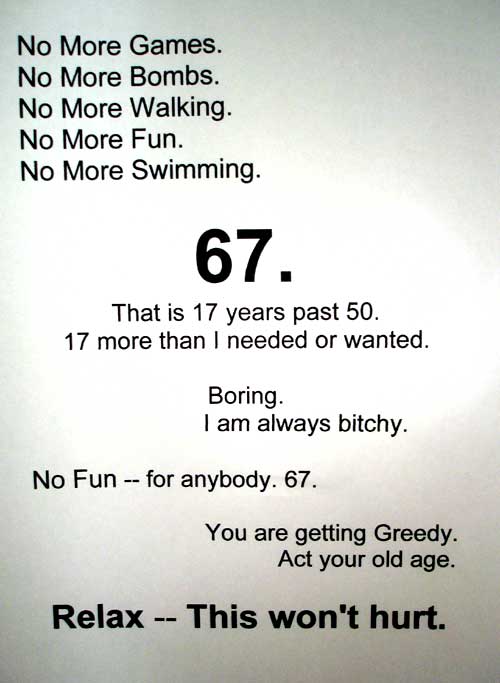
A man used this to help him take his life. I'm hoping that it gives me some instead. Football season's almost over. Baseball season starts soon.

Thursday, December 14, 2006

Loss and Return

There are a few moments in life when people can start over. Transgressions are washed away. Memories of the past are no longer automatically tied to the present state of the individual.

Tomorrow should be that day for a small group whose lives are now forever bound by an act, still unclear, which took place a handful of years ago. The destruction which took place can now finally be repaired. No longer will artificial barriers keep them from confronting their selves and each other.

But more importantly, tomorrow is when a son, brother, and friend will come home. To be held and nurtured. To throw a baseball and shoot a basketball. To gamble and hunt. To laugh and cry. To begin anew.

I love you.

Monday, December 11, 2006

(Tryin' To) Do The Right Thing

Before I went into practice, every attorney I talked to said that I needed to be prepared to give more than legal advice to my clients. Attorneys are considered by their clients to be counselors, priests, minor-miracle workers, etc. Fine, I thought, I feel as if I'm a pretty good friend to have, and that's probably what most people need, so I'm set. Well, was I fucking off, to say the least.

Clients do not just need lawyers, but grief therapists, mental health professionals, financial analysts, and parents, just to name a few. They need someone who they can ask a question about anything and get an answer back that they not only want to hear, but can actually implement. Obviously, a single attorney is not qualified to even begin all of these tasks. (I find myself struggling to answer all of their legal questions.) But this fact actually matters little to those who come to us. As it should.

But it puts lawyers in an extremely difficult position. Often the demands made upon them by clients cut into the time they would be spending researching and writing, the hallmarks of any good, compentent lawyer. Not only does a lawyer feel the stress associated by having to fix their clients' problems, but it is compounded when they realize that after they are done solving one dilemma, they must attend to the routine, everyday business an attorney is expected do.

What makes this all the more frustrating are situations like what happened with me today. A client wanted to meet. It was unscheduled, but necessary because of some recent events in which she had been involved. I had other work that had to get done, but penciled her in for the afternoon. We ended up meeting, and I gave her advice on what she needed to do with an aspect of her life. I didn't feel as if I was being paternalistic, but simply trying to convey that her behavior not only threatened her case, but was endangering the relationships she has with her children. Looking back on it, it may have seemed forward, but because of what she had done, I felt it was called for.

To make a long story short, there is now a probability we might lose her. I made a judgment call based on what I felt was in her best interests as a person and not simply in the litigation. Apparently, though, I gave her an answer that not only could she not implement, she didn't even want to begin to hear. My partners backed my decision to confront even before all of this occurred, but I was still left feeling hurt.

I stepped in a role to which I am often called. And rather than doing the best thing for the case and making her happy, I did the best thing for her self. It goes back to something I wrote in the last post: the law is a business now. But what I left out is not only do lawyers perpetuate it, but so do a lot clients. The best-intentioned client can say money doesn't matter, but when those dollars become a greater reality, it's a whole different ballgame. All of a sudden their case becomes a mortgage payment, a new car, or some better clothes. They no longer really want that advisor, but a "yes" man. And when that happens, doing the right thing can become a whole lot harder.

Sunday, November 12, 2006

Welcome to the Law

I understand sometimes why people think lawyers, particularly personal injury ones, are monsters. And I fear that this essay will not go far in changing any opinions. But there is such a striking similarity between representing plaintiffs and another one of my favorite past-times that I can't help but think it's worth noting. The past-time? Gambling.

I love to gamble. Cards and casino games aren't really my favorites. What I'm hooked on are spreads/lines/points. The closer, the better and the more money I'm willing to put up. Large spreads are trouble, unless you KNOW you got a sure thing. Of course the more money you're willing to dump, the more satisfying your payoff will be.

Personal injury litigation operates on pretty much the same principles. Law firms for plaintiffs are expected to front all of the money for their clients. They get stuck with the tab for experts, tests, etc., especially if they don't win. If your client recovers, you can take out the costs from the verdict. But if the defendant prevails, you get nada, except the (un)healthy debt you've just managed to rack up.

Therefore, it's in the attorney's best interest to sit down when a case comes across their desk, and look at it much the same as a weekend-handicapper would. If it's going to be close and you got a good shot, then perhaps you think about laying it all out. If it's looking risky, then you skip it and go down the table to the next game. But of course you always shake your head when somebody else nails it, gets the payday, and you think, "Man, I should have picked it."

And the defendant is most definitely the house. Chances are they got more money than you and will go to any lengths, including bending the rules, to insure that at the end of the night you are the one with your pockets picked.

The sad fact is that instead of being spokesmen for our clients, the current state of the legal world has forced attorneys to become advocates for themselves. Firms, especially, new ones, can be made or broken by one verdict or settlement. We are gambling not only with the lives of our clients, but also our entire financial well-being.

And much like gambling, the law has become a business, instead of being the profession it once was. I don't like it, but it's true. The relationship between plantiff lawyers and defense ones mirrors that of bettor and bookie. Neither really like each other, but both know the other is necessary to get their payoff.

It all makes me wish I had been born during the time of Clarence Darrow and William Jennings Bryan, when lawyers knew for who and what they were arguing. Instead, I'm left trying to figure out how long I can do it for before I get sick of it and myself. Like all degenerate gamblers.