Thursday, December 21, 2006

A Conversation With The Good Doctor


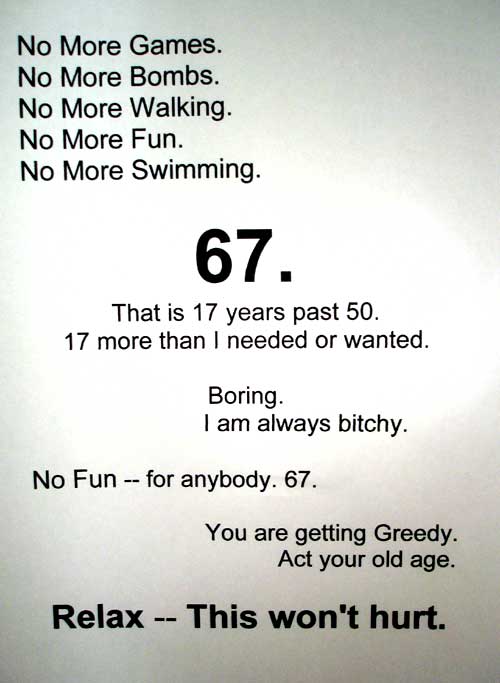
A man used this to help him take his life. I'm hoping that it gives me some instead. Football season's almost over. Baseball season starts soon.

Thursday, December 14, 2006

Loss and Return

There are a few moments in life when people can start over. Transgressions are washed away. Memories of the past are no longer automatically tied to the present state of the individual.

Tomorrow should be that day for a small group whose lives are now forever bound by an act, still unclear, which took place a handful of years ago. The destruction which took place can now finally be repaired. No longer will artificial barriers keep them from confronting their selves and each other.

But more importantly, tomorrow is when a son, brother, and friend will come home. To be held and nurtured. To throw a baseball and shoot a basketball. To gamble and hunt. To laugh and cry. To begin anew.

I love you.

Monday, December 11, 2006

(Tryin' To) Do The Right Thing

Before I went into practice, every attorney I talked to said that I needed to be prepared to give more than legal advice to my clients. Attorneys are considered by their clients to be counselors, priests, minor-miracle workers, etc. Fine, I thought, I feel as if I'm a pretty good friend to have, and that's probably what most people need, so I'm set. Well, was I fucking off, to say the least.

Clients do not just need lawyers, but grief therapists, mental health professionals, financial analysts, and parents, just to name a few. They need someone who they can ask a question about anything and get an answer back that they not only want to hear, but can actually implement. Obviously, a single attorney is not qualified to even begin all of these tasks. (I find myself struggling to answer all of their legal questions.) But this fact actually matters little to those who come to us. As it should.

But it puts lawyers in an extremely difficult position. Often the demands made upon them by clients cut into the time they would be spending researching and writing, the hallmarks of any good, compentent lawyer. Not only does a lawyer feel the stress associated by having to fix their clients' problems, but it is compounded when they realize that after they are done solving one dilemma, they must attend to the routine, everyday business an attorney is expected do.

What makes this all the more frustrating are situations like what happened with me today. A client wanted to meet. It was unscheduled, but necessary because of some recent events in which she had been involved. I had other work that had to get done, but penciled her in for the afternoon. We ended up meeting, and I gave her advice on what she needed to do with an aspect of her life. I didn't feel as if I was being paternalistic, but simply trying to convey that her behavior not only threatened her case, but was endangering the relationships she has with her children. Looking back on it, it may have seemed forward, but because of what she had done, I felt it was called for.

To make a long story short, there is now a probability we might lose her. I made a judgment call based on what I felt was in her best interests as a person and not simply in the litigation. Apparently, though, I gave her an answer that not only could she not implement, she didn't even want to begin to hear. My partners backed my decision to confront even before all of this occurred, but I was still left feeling hurt.

I stepped in a role to which I am often called. And rather than doing the best thing for the case and making her happy, I did the best thing for her self. It goes back to something I wrote in the last post: the law is a business now. But what I left out is not only do lawyers perpetuate it, but so do a lot clients. The best-intentioned client can say money doesn't matter, but when those dollars become a greater reality, it's a whole different ballgame. All of a sudden their case becomes a mortgage payment, a new car, or some better clothes. They no longer really want that advisor, but a "yes" man. And when that happens, doing the right thing can become a whole lot harder.

Sunday, November 12, 2006

Welcome to the Law

I understand sometimes why people think lawyers, particularly personal injury ones, are monsters. And I fear that this essay will not go far in changing any opinions. But there is such a striking similarity between representing plaintiffs and another one of my favorite past-times that I can't help but think it's worth noting. The past-time? Gambling.

I love to gamble. Cards and casino games aren't really my favorites. What I'm hooked on are spreads/lines/points. The closer, the better and the more money I'm willing to put up. Large spreads are trouble, unless you KNOW you got a sure thing. Of course the more money you're willing to dump, the more satisfying your payoff will be.

Personal injury litigation operates on pretty much the same principles. Law firms for plaintiffs are expected to front all of the money for their clients. They get stuck with the tab for experts, tests, etc., especially if they don't win. If your client recovers, you can take out the costs from the verdict. But if the defendant prevails, you get nada, except the (un)healthy debt you've just managed to rack up.

Therefore, it's in the attorney's best interest to sit down when a case comes across their desk, and look at it much the same as a weekend-handicapper would. If it's going to be close and you got a good shot, then perhaps you think about laying it all out. If it's looking risky, then you skip it and go down the table to the next game. But of course you always shake your head when somebody else nails it, gets the payday, and you think, "Man, I should have picked it."

And the defendant is most definitely the house. Chances are they got more money than you and will go to any lengths, including bending the rules, to insure that at the end of the night you are the one with your pockets picked.

The sad fact is that instead of being spokesmen for our clients, the current state of the legal world has forced attorneys to become advocates for themselves. Firms, especially, new ones, can be made or broken by one verdict or settlement. We are gambling not only with the lives of our clients, but also our entire financial well-being.

And much like gambling, the law has become a business, instead of being the profession it once was. I don't like it, but it's true. The relationship between plantiff lawyers and defense ones mirrors that of bettor and bookie. Neither really like each other, but both know the other is necessary to get their payoff.

It all makes me wish I had been born during the time of Clarence Darrow and William Jennings Bryan, when lawyers knew for who and what they were arguing. Instead, I'm left trying to figure out how long I can do it for before I get sick of it and myself. Like all degenerate gamblers.

Sunday, October 22, 2006

9.(tie) The Hours/United 93 (aka CCS' Head Explodes)


You want to know why The Hours is on here? Because every man I know hates it, and every woman loves it. And it leads to guys writing the movie off as "gay," "boring," and "typical feminist bullshit." Too bad they don't actually pay attention to what the movie is saying about gender roles in our society and then try to be better boyfriends/husbands.
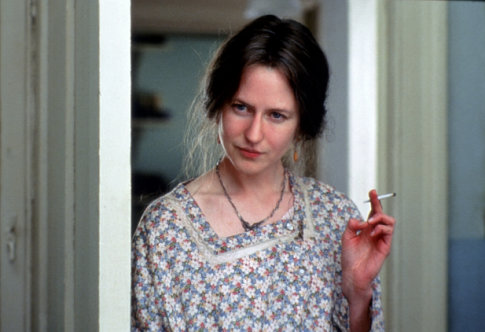
I have had more than one woman tell me that The Hours nails it on the head about how they feel society tells them to behave. Moore's and Kidman's storylines focus around the everyday routine of life which leaves them without meaning and unsatisfied. They cannot be who they want because some outside force (in Moore's case marriage) is impeding them. Moore's act is particularly moving, because it makes you question exactly how many women have given/are giving up the lives and dreams they want so that the hubby and children can pursue their own. Even in today's society where more women are working, how do many often spend their "free-time"? By going after their personal hopes? Or picking up after the kids, doing laundry, and cooking dinner?

The movie centers around the nobility of the fairer sex, and does so by having Ed Harris' character appear in the Streep portion of the film. Harris, who is a poet dying of AIDS, does nothing but lament the injustice of his fate. He has reason to, but he also does what most men do in any relationship with a woman. He makes it all about him. It is his feelings which must come first. Everything must be done on his timetable. While Moore suffers silently in her arc and the audience truely feels for her, Harris takes away any sympathy you might have for his character by behaving selfishly. Moore sets the example, Harris bitches and moans. In other words, The Hours does in fact seem to hit male/female dynamics square on the head and makes it in my opinion one of the best movies of the last 20 years. Not to mention the top-rate acting and the genuine writing.

(In case you think I'm full of shit, go ask a women, who isn't your girlfriend or wife, how they feel about the movie/issue.)

And then there's United 93. It's too bad that the handful of you who read this probably haven't seen it. I can understand why. We live in a country ran by a poor sole of an individual whose administration has politicized 9/11 to such a degree it now makes us feel rather cynical about the whole event. But before you discard Greengrass' fucking masterpiece, try to remember how you felt on that day and the ones immediately following it. Think about the despair, fear, and unknowing.

Moviemaking is an artform. And when done well, it should be commended. But along the lines of why people don't watch the techinal Oscars, they also don't go to the theater for that reason either. People watch a film to be moved, entertained and touched. Most couldn't give fuck what sort of filter was used. The just want to laugh, cry, or see Michael Bay blow something to kingdom come. Maybe it's not intellectual, but it is uniquely human. What makes United 93 great, though, is that it combines the best of both these worlds, and gives each the appropriate amount of respect.

Rather than try to overly-sentimentalize the victims, Greengrass takes almost the opposite approach. He shoots most of the movie in real-time and gives it the feel of a documentary. He rarely uses names, tells little to nothing about the individual characters, and relegates the most "Hollywood" moments to footnote status. ("Let's roll" is barely audible.) He just kind says, "Here it is. You decide." In spite of this, he is still able to pack a tremendous amount of emotion into the film.

I kept having to remind myself, "The plane crashes. You know how this ends." Yet, Greengrass was able to time after time keep getting my hopes up that maybe I just mis-remembered what actually happened that day five years ago. And he was able to send me crashing down with the plane, when they passengers weren't able to regain control, even though I know nothing about them. What allowed him to accomplish this was that he showed you that these people didn't fight back for love of country, political party, or reason to go to war. They did it for themselves, each other, and their families. The passengers sought to regain the plane for the same reasons you, yourself, probably would.

And he did all of this without having to play a single aspect of it up (Attention Oliver Stone.) He knew his audience would be already moved, he just had to make sure you knew why. Never once does he try to give anyone hero status. Yet, by the end you feel as if they all do. It is apolitical, objective, and fair. But most of all, it is representative of all the reasons why we should remember what happened that day.