Sunday, November 12, 2006

Welcome to the Law

I understand sometimes why people think lawyers, particularly personal injury ones, are monsters. And I fear that this essay will not go far in changing any opinions. But there is such a striking similarity between representing plaintiffs and another one of my favorite past-times that I can't help but think it's worth noting. The past-time? Gambling.

I love to gamble. Cards and casino games aren't really my favorites. What I'm hooked on are spreads/lines/points. The closer, the better and the more money I'm willing to put up. Large spreads are trouble, unless you KNOW you got a sure thing. Of course the more money you're willing to dump, the more satisfying your payoff will be.

Personal injury litigation operates on pretty much the same principles. Law firms for plaintiffs are expected to front all of the money for their clients. They get stuck with the tab for experts, tests, etc., especially if they don't win. If your client recovers, you can take out the costs from the verdict. But if the defendant prevails, you get nada, except the (un)healthy debt you've just managed to rack up.

Therefore, it's in the attorney's best interest to sit down when a case comes across their desk, and look at it much the same as a weekend-handicapper would. If it's going to be close and you got a good shot, then perhaps you think about laying it all out. If it's looking risky, then you skip it and go down the table to the next game. But of course you always shake your head when somebody else nails it, gets the payday, and you think, "Man, I should have picked it."

And the defendant is most definitely the house. Chances are they got more money than you and will go to any lengths, including bending the rules, to insure that at the end of the night you are the one with your pockets picked.

The sad fact is that instead of being spokesmen for our clients, the current state of the legal world has forced attorneys to become advocates for themselves. Firms, especially, new ones, can be made or broken by one verdict or settlement. We are gambling not only with the lives of our clients, but also our entire financial well-being.

And much like gambling, the law has become a business, instead of being the profession it once was. I don't like it, but it's true. The relationship between plantiff lawyers and defense ones mirrors that of bettor and bookie. Neither really like each other, but both know the other is necessary to get their payoff.

It all makes me wish I had been born during the time of Clarence Darrow and William Jennings Bryan, when lawyers knew for who and what they were arguing. Instead, I'm left trying to figure out how long I can do it for before I get sick of it and myself. Like all degenerate gamblers.

Sunday, October 22, 2006

9.(tie) The Hours/United 93 (aka CCS' Head Explodes)


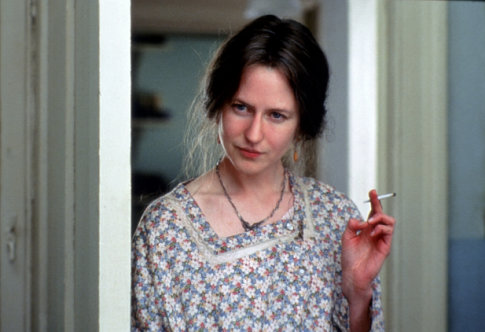
You want to know why The Hours is on here? Because every man I know hates it, and every woman loves it. And it leads to guys writing the movie off as "gay," "boring," and "typical feminist bullshit." Too bad they don't actually pay attention to what the movie is saying about gender roles in our society and then try to be better boyfriends/husbands.

I have had more than one woman tell me that The Hours nails it on the head about how they feel society tells them to behave. Moore's and Kidman's storylines focus around the everyday routine of life which leaves them without meaning and unsatisfied. They cannot be who they want because some outside force (in Moore's case marriage) is impeding them. Moore's act is particularly moving, because it makes you question exactly how many women have given/are giving up the lives and dreams they want so that the hubby and children can pursue their own. Even in today's society where more women are working, how do many often spend their "free-time"? By going after their personal hopes? Or picking up after the kids, doing laundry, and cooking dinner?

The movie centers around the nobility of the fairer sex, and does so by having Ed Harris' character appear in the Streep portion of the film. Harris, who is a poet dying of AIDS, does nothing but lament the injustice of his fate. He has reason to, but he also does what most men do in any relationship with a woman. He makes it all about him. It is his feelings which must come first. Everything must be done on his timetable. While Moore suffers silently in her arc and the audience truely feels for her, Harris takes away any sympathy you might have for his character by behaving selfishly. Moore sets the example, Harris bitches and moans. In other words, The Hours does in fact seem to hit male/female dynamics square on the head and makes it in my opinion one of the best movies of the last 20 years. Not to mention the top-rate acting and the genuine writing.

(In case you think I'm full of shit, go ask a women, who isn't your girlfriend or wife, how they feel about the movie/issue.)

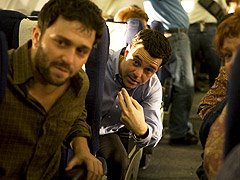
And then there's United 93. It's too bad that the handful of you who read this probably haven't seen it. I can understand why. We live in a country ran by a poor sole of an individual whose administration has politicized 9/11 to such a degree it now makes us feel rather cynical about the whole event. But before you discard Greengrass' fucking masterpiece, try to remember how you felt on that day and the ones immediately following it. Think about the despair, fear, and unknowing.

Moviemaking is an artform. And when done well, it should be commended. But along the lines of why people don't watch the techinal Oscars, they also don't go to the theater for that reason either. People watch a film to be moved, entertained and touched. Most couldn't give fuck what sort of filter was used. The just want to laugh, cry, or see Michael Bay blow something to kingdom come. Maybe it's not intellectual, but it is uniquely human. What makes United 93 great, though, is that it combines the best of both these worlds, and gives each the appropriate amount of respect.

Rather than try to overly-sentimentalize the victims, Greengrass takes almost the opposite approach. He shoots most of the movie in real-time and gives it the feel of a documentary. He rarely uses names, tells little to nothing about the individual characters, and relegates the most "Hollywood" moments to footnote status. ("Let's roll" is barely audible.) He just kind says, "Here it is. You decide." In spite of this, he is still able to pack a tremendous amount of emotion into the film.

I kept having to remind myself, "The plane crashes. You know how this ends." Yet, Greengrass was able to time after time keep getting my hopes up that maybe I just mis-remembered what actually happened that day five years ago. And he was able to send me crashing down with the plane, when they passengers weren't able to regain control, even though I know nothing about them. What allowed him to accomplish this was that he showed you that these people didn't fight back for love of country, political party, or reason to go to war. They did it for themselves, each other, and their families. The passengers sought to regain the plane for the same reasons you, yourself, probably would.

And he did all of this without having to play a single aspect of it up (Attention Oliver Stone.) He knew his audience would be already moved, he just had to make sure you knew why. Never once does he try to give anyone hero status. Yet, by the end you feel as if they all do. It is apolitical, objective, and fair. But most of all, it is representative of all the reasons why we should remember what happened that day.

Thursday, October 12, 2006

How Do You Have A Job?

I'm a freshly minted lawyer, and practice with a couple of other people. Two of us were filling out paperwork today for malpractice insurance. Now, the company we're going through has only one set of forms for everybody. So, whether you've lost your carrier 50 times or just starting out, everyone has to answer the same shitty questions.

This becomes important because most of the questions assume that you've had some experience. Unfortunately, that's not us. And makes the question about how much of your billable hours are devoted to varying areas of the law a little difficult to answer. So, I call the wonderful people up to ask what the hell are we supposed to do. And the conversation went a little something like this:

"Hello, this is Black-Hole-of-Life, how may I help you?" in the the least helpful voice ever.

"Um, yes, Black-Hole-of-Life, I'm a new attorney with a new firm, and I was wondering if there was an additional/special application we should fill out as many of these questions do not seem applicable to us?"

"No, there is only the one application."

"Um, well, okay. The reason I asked is because of the question regarding percentage of practice. How do you suggest we fill it out?"

"Well, you should just approximate what you believe they might be."

"Approximate."

"Yes."

Uh-huh. So, let me get this right. The representative for the insurance company just told me to guess on the form I fill out to set my premium. Fan-fucking-tastic. My partner and I could wind up shelling out 6 grand a month, and Black-Hole-of-Life just told me that I might have just as well thrown darts at a board than call her up. What a country. I hate insurance companies.

Tuesday, October 10, 2006

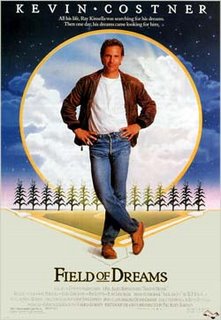
10.(tie) Menace II Society/Field of Dreams


Okay, there's actually twelve on the list. (No. 9 is a tie, too.) Let's start with Menace.

It came out in 1993 as a response to John Singleton's Boyz n the Hood. See, the Hughes brothers didn't think that Singleton's pic was tough enough. So, they made their own L.A. gang-banger pic. And what a goddamn response it was, especially since they made this movie when they were 21. It has all of the same elements as Boyz: A born and bred gang-banger, someone thinking about leaving the hood, girlfriends, strong/weak parental figures, cops, and violence. But it is all done at such a dirtier, grimier level, you just feel as if the characters are more human and act/react they same way you would. In other words, Albert and Allen accomplished what they set off to do. Look at the characters themselves.

Clearly, in Boyz, Doughboy, Tre, and Ricky are supposed to represent individual segments of the black population, and while they all interact with each other, Singleton never really lets them go beyond the type of man each is supposed to be. The Hughes Brothers just said fuck it. Everyone's got weaknesses, so why not have our characters show that. Caine is clearly supposed to be their Tre. But unlike Tre, he is also part fucking Thug. Such as when he tells the girl he knocked up that it can't be his kid, because he "had the jimmy-hat on extra-tight." O-Dog, who is supposed to counter Doughboy, actually makes you wonder if Tate was the one who wrote all of NWA's lyrics, as opposed to Cube. Doughboy is tough, but in the end you kind of like him. On the other hand, you fucking fear O-Dog and silently hope that he dies, too afraid to actually say it on the off-chance he might actually come through the goddamn screen.

Finally, the violence. Simply, you knew when it was coming in Boyz, you never did in Menace. You knew Ricky was a dead man, but don't tell me you knew O-Dog was going to shoot the bum who offered to suck his dick and then eat the dude's fucking hamburger. Jesus Christ. Boyz was good and deserved much of the praise it got because it was original. But this movie tops it in every way.

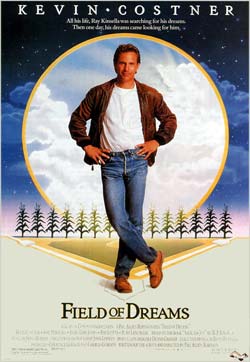
On a lighter note, there's Field of Dreams. I know, some of you are thinking it's just typical Hollywood sentimental schlock. It's not, but I'll get to that in a minute. First and foremost, the movie is about baseball, obviously. And in today's world of Barry Bonds, the film takes on cultural significance simply because of that. Sports has had, and will always have, an important role in the lives of many Americans, and until my generation, baseball was king. This movie serves as a reminder to why that was, and maybe should be again. In it's purest form, baseball is a beautiful sport. It's simplicity and complexity work so well together, it's impossible not to wonder if a more perfect sport has been created. (I argue yes, but I think baseball has a pretty good case.)

Second, the movie is about the 60's and what happened to flower power after Ronald Reagan. A little bit of this story line exists in the relationship between Annie and Ray Kinsella. But it is brought to perfection with James Earl Jones' character, Terrence Mann. Mann, the author of the fictionalized work, The Boat Rocker, is a writer who just always wanted to be that. He seems to have once embraced what the sixties were about, but after having to listen to one too many stories about how people rebelled against their parents, he is now completely burnt-out and living by himself. In the end, I think it works as a beautiful analogy for that time period.

Finally, the movie is about fathers and sons and the reason that I say the movie is more than just sentimental fluff. I saw the movie for the first time when I was young enough to still unquestionably love my father, and thought it pretty good. But it wasn't until I had lived a few more years that I really got it. In the film, you learn that Ray's father had at one time been a pro ball player long before he was born. Costner never really got a chance to know that part of his dad, and only knew him after life had worn him down. Largely because of this, Ray's relationship with his father was strained, culminating in him moving out when he was in his early teens after reading Mann's book and not coming home when his dad became ill. The regret he feels is told through Kinsella lamenting about how he stopped playing catch with his old man and it feels unbelievably real.

My dad and I never got along too well when I reached high school and throughout the time I was in college. But the one thing we always had that we could talk about or bond over was sports. We shot basketball, threw the football, and pitched the occasional baseball. And when we were done with that, we would watch them on television. All of it together. One summer though we didn't talk to each other. Not a single word, June through August.

Field of Dreams ends with Kinsella finding his dad, John, out on the baseball diamond. Ray recognizes him, but his dad does not, or so we're led to believe. They talk for a couple of minutes, with Ray complimenting him on his game and introducing John to his granddaughter. As the older Kinsella turns to leave, Ray goes, "Hey, dad...wanna have a catch?" John agrees, and the movie slowly fades out. I cry every goddamn time. You can probably guess why.

The last shot is of a line of cars, going on for miles, heading towards the diamond. To me, it symbolizes all of the people who wish they could have those moments, like Ray's, back with their parents. I know I want that summer back.

"Is this heaven?"

"No, it's Iowa."

My Top 10 Movies

Everyone is doing/or has done one of these, so why not me? I also figured that I would select seem which might cause blood pressures to rise (jff-I'm looking at you). So here are the criteria. (1) Movies must have been considered for Oscar nomination from 1987-2006. I started seeing movies at the theater about then, and it covers the last twenty years. It's a substantial block of time, but also one in which I feel it is really fair to compare individual films. All-time lists are mistaken, in my opinion, because styles of directing/acting/writing change. Other art forms seem to recognize this, so why not movies as well? (2) No documentaries, only dramatizations. I love doc.s, but don't really feel its fair to compare the two types. (Sorry Hoop Dreams.) (3) I have to have seen it in the movie theater. Seeing a film on the silver screen is vastly different than seeing it on a T.V. And because I think seeing it with a group of people in a darkened room is just as important sometimes as the movie itself, I'm going to limit the list this way. Why is this significant? I saw the following movies on tape for the first time: The Usual Suspects, Platoon, Born on the Fourth of July, Silence of the Lambs...oh, and Goodfellas.